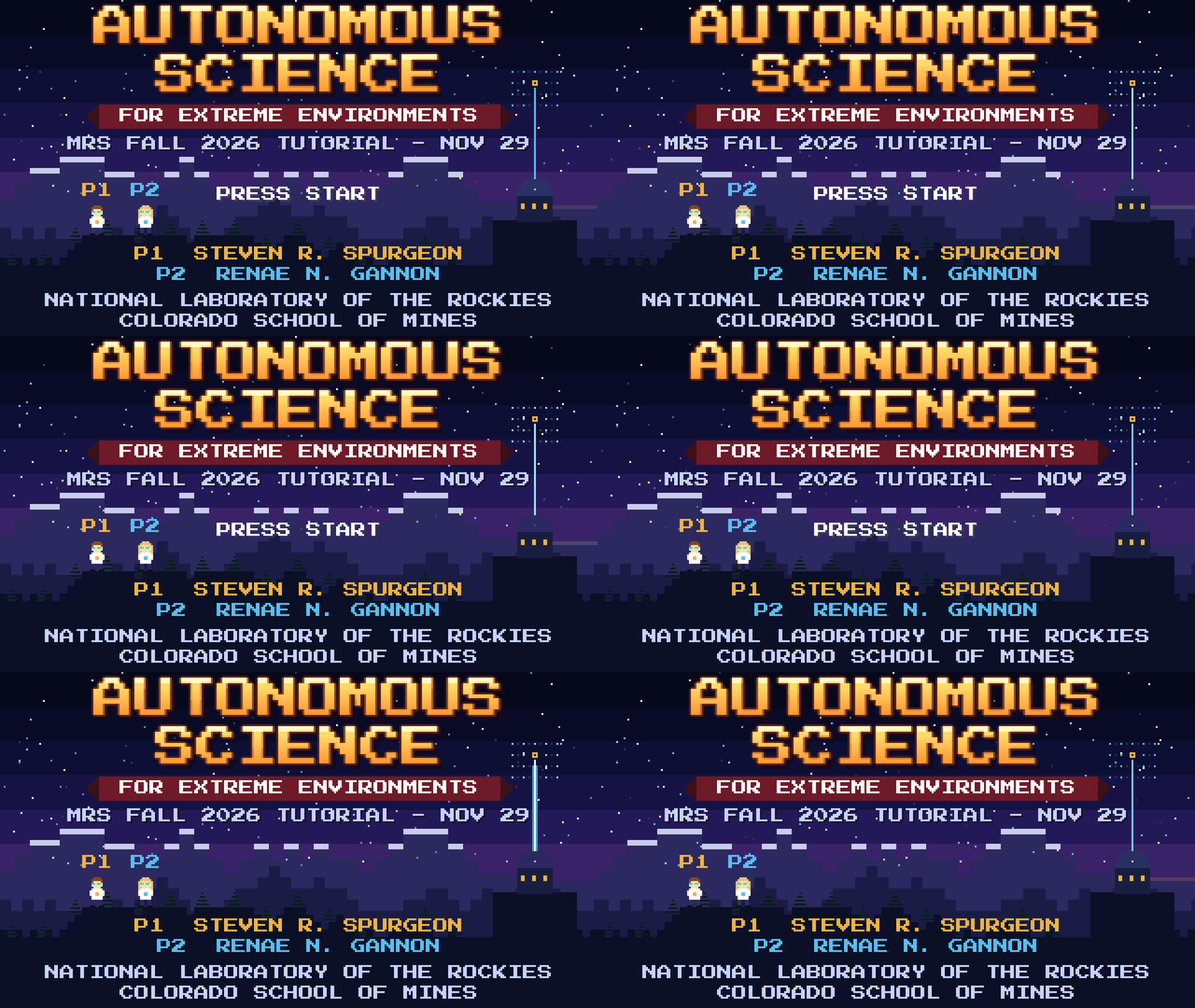
This guide accompanies the tutorial that Renae Gannon and I are giving at the MRS Fall 2026 Meeting in Boston, Autonomous Science for Extreme Environments: From Radiation to Microgravity. It builds on the guide I wrote after the McMaster CCEM Summer School, and I have kept much of that intact, because the same historical context applies. However, things have been rapidly changing over the last year and now we are seeing language agents planning, operating, and reasoning on incredibly complex experiments.
The central message of our tutorial is that autonomy must be build on one validated function and experiment at a time; deployment is really the bottleneck. AI is increasingly accelerating scientific discovery and is not yet a replacement for it.
1. Building a Conceptual Foundation (Online Courses)
Before diving into complex code or research papers, it's crucial to build a strong conceptual intuition for how machine learning works. These courses are exceptional starting points that prioritize understanding over abstract mathematics.
Machine Learning Specialization by Andrew Ng (Coursera)
Who it's for: The absolute beginner. This is widely considered the definitive "first course" in machine learning for a reason.
What you'll learn: Dr. Ng has a gift for explaining the core ideas of supervised and unsupervised learning, including regression, classification, and clustering, with brilliant clarity. You will come away understanding the "why" behind the algorithms.
Deep Learning Specialization by Andrew Ng (Coursera)
Who it's for: Those who have completed the introductory course and want to understand the architecture of modern AI.
What you'll learn: This specialization demystifies neural networks, convolutional neural networks (CNNs) for image analysis, and the strategies used to train these powerful models effectively.
Practical Deep Learning for Coders by fast.ai
Who it's for: Those who prefer a "top-down," code-first approach. It's perfect for the experimentalist who wants to start applying models quickly and learn the theory along the way.
What you'll learn: You'll learn how to build and train state-of-the-art deep learning models using the PyTorch library with a focus on practical results and best practices.
2. The Practitioner's Toolkit (Key Software & Libraries)
Your research will ultimately be done through code. The open-source community has built an incredible ecosystem of tools that are free to use and supported by excellent documentation. Most of these tools are based in the Python programming language.
The Deep Learning Frameworks: TensorFlow & PyTorch
These are the two titans of deep learning. You don't need to know both; choose one and go deep. They provide the fundamental building blocks for creating and training neural networks. My group has used both to great effect in our work.
The Classical ML Workhorse: Scikit-learn
For any task that doesn't require a deep neural network (e.g., clustering, classical regression, dimensionality reduction like PCA), Scikit-learn is the gold standard. It's incredibly user-friendly and powerful.
Model Exchanges: Hugging Face
There are many models that have been developed that you can adapt for your own problems. Hugging Face is one such exchange that can help you quickly get up to speed.
Domain-Specific Tools for Microscopy & Materials
Atomap: A foundational open-source tool for finding and fitting atomic column positions in high-resolution images using 2D Gaussian fitting. Our TEMWizard software was built to provide a graphical interface for this library.
AtomAI: A powerful PyTorch-based toolkit that connects deep learning models to experimental microscopy data, enabling analysis of atomic and mesoscale images and spectroscopy.
HyperSpy: An essential open-source Python library for analyzing multi-dimensional data, including electron energy loss spectroscopy (EELS) and energy-dispersive X-ray spectroscopy (EDS) datacubes.
py4DSTEM: A specialized toolkit for the analysis of 4D-STEM datasets, a rapidly growing area of research.
New: Instrument Control and Agents
Analysis is only half of autonomy. To close the loop, a model has to reach the instrument, and this is where much of the practical work now lives.
Vendor Python APIs: Most modern instruments expose some level of scripting, such as Thermo Fisher AutoScript, JEOL's PyJEM, and Python in Gatan DigitalMicrograph. My best advice is to find out exactly what your instrument's API exposes, and then wrap and validate one function at a time. Every function you validate becomes a building block that a person, a script, or an agent can call safely.
The Model Context Protocol (MCP): An open standard for exposing tools and data to language models. It is quickly becoming a common way to connect agents to instruments, data platforms, and computing resources, and several of the papers below are built on it.
Emulators and digital twins: Test an agent against a simulated instrument before you give it beam time. An emulator lets you watch how an agent plans, where it misreads a request, and where it should stop and ask, with nothing at risk.
3. Seminal & Foundational Papers: Your Reading List
Staying current means reading the literature. This list is not exhaustive, but it provides a starting point with papers that established a new concept, provide a vision for the future, or demonstrate a particularly insightful application in our field. I have organized them by theme to help guide your reading.
The Deep Learning Revolution (General)
Krizhevsky, A., Sutskever, I., & Hinton, G. E. (2012). "ImageNet classification with deep convolutional neural networks." Communications of the ACM, 60(6), 84-90.
Why it's important: This is the "AlexNet" paper that kickstarted the modern deep learning revolution. It demonstrated that deep neural networks, trained on massive datasets with GPU hardware, could dramatically outperform all previous methods in image classification.
Core Task: Feature Identification and Segmentation
Nord, M., et al. (2017). "Atomap: a new software tool for the automated analysis of atomic resolution images using two-dimensional Gaussian fitting." Advanced Structural and Chemical Imaging, 3(1), 9.
Why it's important: This paper details the classic model-based approach to finding atoms. It is a powerful technique and provides an important baseline for understanding the advantages of deep learning-based methods.
Ziatdinov, M., et al. (2017). "Deep Learning of Atomically Resolved Scanning Transmission Electron Microscopy Images: Chemical Identification and Tracking Local Transformations." ACS Nano, 11(12), 12742-12752.
Why it's important: This was an important paper demonstrating how deep learning could be used to find and classify atomic-scale features and defects directly from experimental STEM data, paving the way for many of the applications we see today.
Akers, S., Kautz, E., et al. & Spurgeon, S.R. (2021). "Rapid and flexible segmentation of electron microscopy data using few-shot machine learning." npj Computational Materials, 7(1), 187.
Why it's important: This work from my team addresses a key bottleneck in real-world science: the "sparse data" problem. We show how few-shot learning can be used to segment complex microstructures with minimal human-labeled examples, dramatically speeding up analysis.
Guinan, G., et al. & Spurgeon, S.R. (2026). "Revealing the Hidden Third Dimension of Point Defects in Two-Dimensional MXenes." Nature Communications, 17, 3473. DOI: 10.1038/s41467-026-71670-y
Why it's important: Point defects govern the stability and performance of MXenes, but counting them by hand is slow and subjective. This work shows how ML segmentation turns individual atomic-resolution images into defect statistics that can be compared across processing routes, which is the step that makes perception useful for materials design.
Advanced Task: Discovery, Forecasting, and New Modalities
Ter-Petrosyan, A.H., et al. & Spurgeon, S.R. (2023). "Unsupervised segmentation of irradiation-induced order-disorder phase transitions in electron microscopy." Proceedings of the Thirty-Seventh Conference on Neural Information Processing Systems (NeurIPS).
Why it's important: This paper demonstrates a true discovery capability. We developed an unsupervised model that can identify hidden order-disorder transitions in irradiated materials without any prior human labels, showcasing the power of AI for exploring unknown phenomena.
Lewis, N., Jin, Y., et al. & Spurgeon, S.R. (2022). "Forecasting of in situ electron energy loss spectroscopy." npj Computational Materials, 8(1), 252.
Why it's important: Moving beyond static images, this work shows how recurrent neural networks can forecast the evolution of spectroscopic signals during in situ experiments. This is a critical step toward predictive control of dynamic processes at the nanoscale.
Liu, Y., et al. (2023). "Learning the right channel in multimodal imaging: automated experiment in piezoresponse force microscopy." npj Computational Materials, 9, 34.
Why it's important: This work shows the breadth of ML applications beyond TEM/STEM, demonstrating a sophisticated deep kernel learning approach to automatically analyze complex domain structures in piezoresponse force microscopy (PFM) data.
New: Language Agents in the Laboratory
This is the fastest-moving part of the field, and the papers below are a snapshot rather than a settled canon. I have chosen them because each one makes a different design choice about how much the agent is allowed to do on its own, which is the question our tutorial centers on.
Boiko, D.A., MacKnight, R., Kline, B., & Gomes, G. (2023). "Autonomous chemical research with large language models." Nature, 624, 570-578.
Why it's important: "Coscientist" was one of the first demonstrations that a language model could plan and execute real experiments by searching documentation, writing code, and driving laboratory hardware. It set the template that much of the later work builds on.
Bran, A.M., et al. (2024). "Augmenting large language models with chemistry tools." Nature Machine Intelligence, 6, 525-535.
Why it's important: "ChemCrow" established the pattern of giving a language model a curated set of expert tools rather than asking it to do everything itself. That idea, an agent reasoning above a registry of validated functions, is central to how we build agents for instruments.
Mandal, I., et al. & Krishnan, N.M.A. (2025). "Evaluating large language model agents for automation of atomic force microscopy." Nature Communications, 16, 9104. DOI: 10.1038/s41467-025-64105-7
Why it's important: This paper introduces AILA, an agent framework for atomic force microscopy, together with a benchmark of how agents actually perform on instrument tasks. Its value lies as much in the failure modes it documents as in what works, and it is essential reading before you trust an agent with your own instrument.
Wall, M.K., Pattison, A.J., Barnard, E.S., Ribet, S.M., & Ercius, P. (2026). "TEM Agent: enhancing transmission electron microscopy (TEM) with modern AI tools." npj Computational Materials. DOI: 10.1038/s41524-026-02103-z (preprint: arXiv:2511.08819)
Why it's important: Working at the Molecular Foundry, Peter Ercius and his colleagues use the Model Context Protocol to let a commercial language model control several microscope subsystems, a data management platform, and high-performance computing through plain-language instructions. It shows how much complexity an agent can hide from the user on a multi-vendor instrument.
Chen, Z., et al. (2026). "An agentic artificially intelligent X-ray scientist." Nature Machine Intelligence. DOI: 10.1038/s42256-026-01261-5
Why it's important: This agent sets up and runs X-ray diffraction experiments, aligning samples, reading detector outputs, and adjusting the instrument as it goes, including recovering from a hardware glitch mid-experiment. It is a strong example of an agent that acts with considerable independence, and a useful contrast to designs that keep a person at key decision points.
Du, M., et al. & Cherukara, M.J. (2026). "EAA: Automating Materials Characterization with Vision Language Model Agents." arXiv:2602.15294.
Why it's important: This work from Argonne brings vision-language agents to synchrotron microscopy, combining image-aware reasoning with tool use and compatibility with the Model Context Protocol. It is a reminder that the same agent patterns are spreading across photon, electron, and probe instruments.
dos Reis, R., & Dravid, V.P. (2026). "Schema-Bound LLM Control of Scientific Instrumentation through Model Context Protocol Skills." arXiv:2607.17012.
Why it's important: This framework checks every instrument command against physical limits before it executes, and packages multi-step procedures as reusable skills. It has so far been validated against a simulator, but its emphasis on enforceable bounds speaks directly to the safety questions every lab will face.
Borch, A., et al. & Spurgeon, S.R. (2026). "Balancing Autonomy and Oversight in Language-Agent-Guided Physical Experimentation." Preprint, Research Square. DOI: 10.21203/rs.3.rs-10671592/v1
Why it's important: This is our work on ADAM, an agent that plans and executes experiments across electron microscopes and focused ion beams. Rather than asking a person to approve every step, or none, ADAM infers where an action stops being reversible and pauses for a human there. We think this reversibility boundary is the right place to draw the line between autonomy and oversight, particularly when the experiment changes the sample.
New: Processing with Ion Beams
Our tutorial moves from characterization, where the sample is usually left intact, to processing, where every cut is permanent. These references cover the physical foundations.
Giannuzzi, L.A., & Stevie, F.A. (Eds.) (2005). Introduction to Focused Ion Beams: Instrumentation, Theory, Techniques and Practice. Springer.
Why it's important: This remains the standard introduction to how focused ion beams work, from ion sources and ion-solid interactions to milling, deposition, and sample preparation. Understanding the physics is the first step toward knowing which decisions an automated system can safely make.
[Renae: add one or two picks on plasma FIB and automated or vision-guided milling.]
The Vision: Reviews, Perspectives, and Autonomous Science
Spurgeon, S.R., Ophus, C., et al. (2021). "Towards data-driven next-generation transmission electron microscopy." Nature Materials, 20(3), 274-279.
Why it's important: My collaborators and I laid out a community perspective and a vision for the future of microscopy, arguing for a move toward data-centric, AI-driven workflows to accelerate discovery.
Olszta, M., et al. & Spurgeon, S.R. (2022). "An automated scanning transmission electron microscope guided by sparse data analytics." Microscopy and Microanalysis, 28(5), 1611-1621.
Why it's important: Here, we moved from post-analysis to active experimentation. We detailed the development of the "AutoEM" platform, which embeds AI directly into the microscope control loop, enabling the instrument to make intelligent decisions on the fly.
Dyck, O., Ziatdinov, M., Lingerfelt, D.B., et al. (2019). "Atom-by-atom fabrication with electron beams." Nature Reviews Materials, 4, 497-507.
Why it's important: This paper reviews the remarkable progress at ORNL in autonomously manipulating individual atoms to create custom atomic structures based on a predefined blueprint.
Guinan, G., Salvador, A., et al. & Spurgeon, S.R. (2025). "Mind the gap: Bridging the divide between AI aspirations and the reality of autonomous microscopy." APL Machine Learning, 3. (preprint: arXiv:2502.18604)
Why it's important: This perspective takes an honest look at what still stands between today's demonstrations and routine autonomous microscopy, including imprecise stage motion, limited software interoperability, and the lack of shared benchmark datasets. These practical barriers are where much of the real work lies.
Kalinin, S.V., et al. (2026). "Do We Really Need All That Data: From Data to Agency in Automated Microscopy." Microscopy Today, 34(3), 16. DOI: 10.1093/mictod/qaag035
Why it's important: Sergei Kalinin and colleagues, myself included, argue that the limiting factor in microscopy is not data throughput but agency: the ability to make good experimental decisions quickly, reliably, and safely. The piece lays out what it will take to scale agency beyond bespoke demonstrations, including instrument orchestrators, provenance-first records, deterministic replay, and emulators with enforceable guardrails.
Born-Qualified: An Autonomous Framework for Deploying Advanced Energy and Electronic Materials (2026).arXiv:2605.00639.
Why it's important: This multi-institution perspective extends autonomy beyond discovery to qualification, asking how autonomous synthesis, processing, and characterization can produce materials that are ready for deployment rather than just new. It frames why processing, not only characterization, needs to become autonomous.
4. Communities & Research Groups to Follow
Science is a collaborative effort. Following the work of leading groups and participating in community events is a great way to stay inspired and informed.
Influential Research Groups
Sergei V. Kalinin (University of Tennessee, Knoxville): A true pioneer in the application of AI and automated experimentation to scanning probe and electron microscopy.
Alán Aspuru-Guzik (University of Toronto) and the Acceleration Consortium: A leader in the broader concept of "self-driving laboratories" for accelerating chemical and materials discovery.
Peter Ercius (Molecular Foundry, Lawrence Berkeley National Laboratory): Bringing agents and modern AI tools to some of the most advanced electron microscopes in the world.
Mathew Cherukara (Argonne National Laboratory): Leading work on AI agents for synchrotron and X-ray microscopy.
My research group and collaborators: The TIME Research Group at the Colorado School of Mines, together with my colleagues at the National Laboratory of the Rockies (NLR), including my co-instructor Renae Gannon, whose work focuses on autonomous materials processing. Our work centers on autonomous science for functional materials and extreme environments.
Professional Societies & Meetings
Microscopy Society of America (MSA): The annual Microscopy & Microanalysis meeting is the premier venue for our field. We regularly organize symposia on AI and data science there.
Materials Research Society (MRS): The MRS Spring and Fall meetings are essential for materials scientists, with a rapidly growing number of symposia dedicated to data science, AI, and automated discovery.
AI microscopy hackathons: Community hackathons, such as those organized by Sergei Kalinin's group with remote sites around the world, are one of the best ways to get hands-on experience with real microscopy data and meet others working in this space.
I hope this guide gives you both a starting point and a sense of where the field is heading. The tools to see are mature, the tools to decide are arriving quickly, and the hardest and most interesting work now lies in deciding what our instruments should be trusted to do on their own. If you attended our tutorial, thank you, and I look forward to seeing what you build.