Preprint: Solving Cr₂O₃ / β-Ga₂O₃ Interfaces
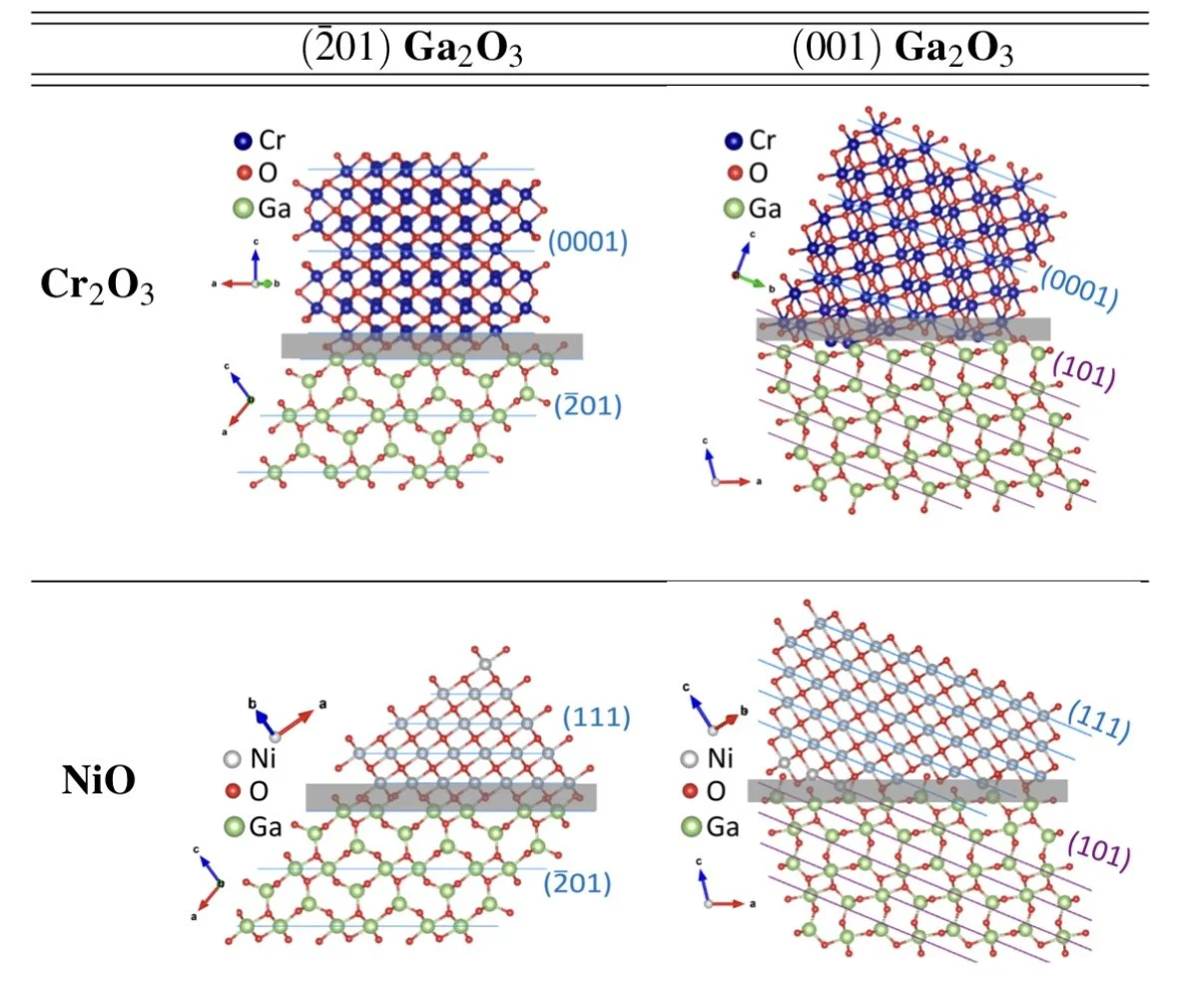
Anna Sacchi and Andriy Zakutayev led this new study from our APEX EFRC team, with Krishna Acharya, Michelle A. Smeaton, Renae N. Gannon, Vladan Stevanovic, M. Brooks Tellekamp, and myself, examining the epitaxial relationship of Cr₂O₃ and NiO p-type oxide contacts on β-Ga₂O₃. These contacts stand to be the enabling layer for bipolar Ga₂O₃ device architectures, given the material's intrinsic lack of p-type conductivity, and device performance for both systems has already been demonstrated with breakdown fields and voltages competitive with other wide-bandgap platforms.
In spite of this, the epitaxial relationship underpinning these heterojunctions has remained less clearly established for the (001) substrate orientation that dominates commercial use. Prior studies reported a single alignment, Cr₂O₃ (0001) ∥ Ga₂O₃ (2̄01), a relationship confirmed for the (2̄01) substrate and then extended to (001) without the same level of independent verification.
The team's work finds a different picture for (001). No Cr₂O₃ or NiO planes align parallel to the substrate surface; both instead align to the (101) planes, tilted 22.5° from the surface normal. Two relevant substrate reflections sit only 0.01° apart in 2θ, close enough to be conflated by instruments with lower angular resolution, which may account for the discrepancy with earlier reports.
Resolving the true alignment required combining a wide-angle powder diffractometer with a high-resolution instrument capable of targeted off-axis scans. The team explains the alignment through oxygen sublattice equivalence: the (101) and (2̄01) Ga₂O₃ planes present nearly identical anion arrangements once the monoclinic cell is mapped onto its pseudo-cubic oxygen framework, and DFT-based Lennard-Jones interface modeling independently identifies the same low-energy configuration. They also resolved the in-plane relationship for Cr₂O₃ on (2̄01) Ga₂O₃, Cr₂O₃ [12̄30] ∥ Ga₂O₃ [010], and documented two 60°-rotated in-plane twin domains, a detail with direct consequences for anisotropic carrier transport at the interface. Beyond the specific Ga₂O₃ result, the combined XRD/DFT methodology offers a template for resolving epitaxial relationships at high/low-symmetry heterointerfaces more broadly.
Read the preprint here: https://doi.org/10.48550/arXiv.2609.22472