New Publication: Do We Really Need All That Data?
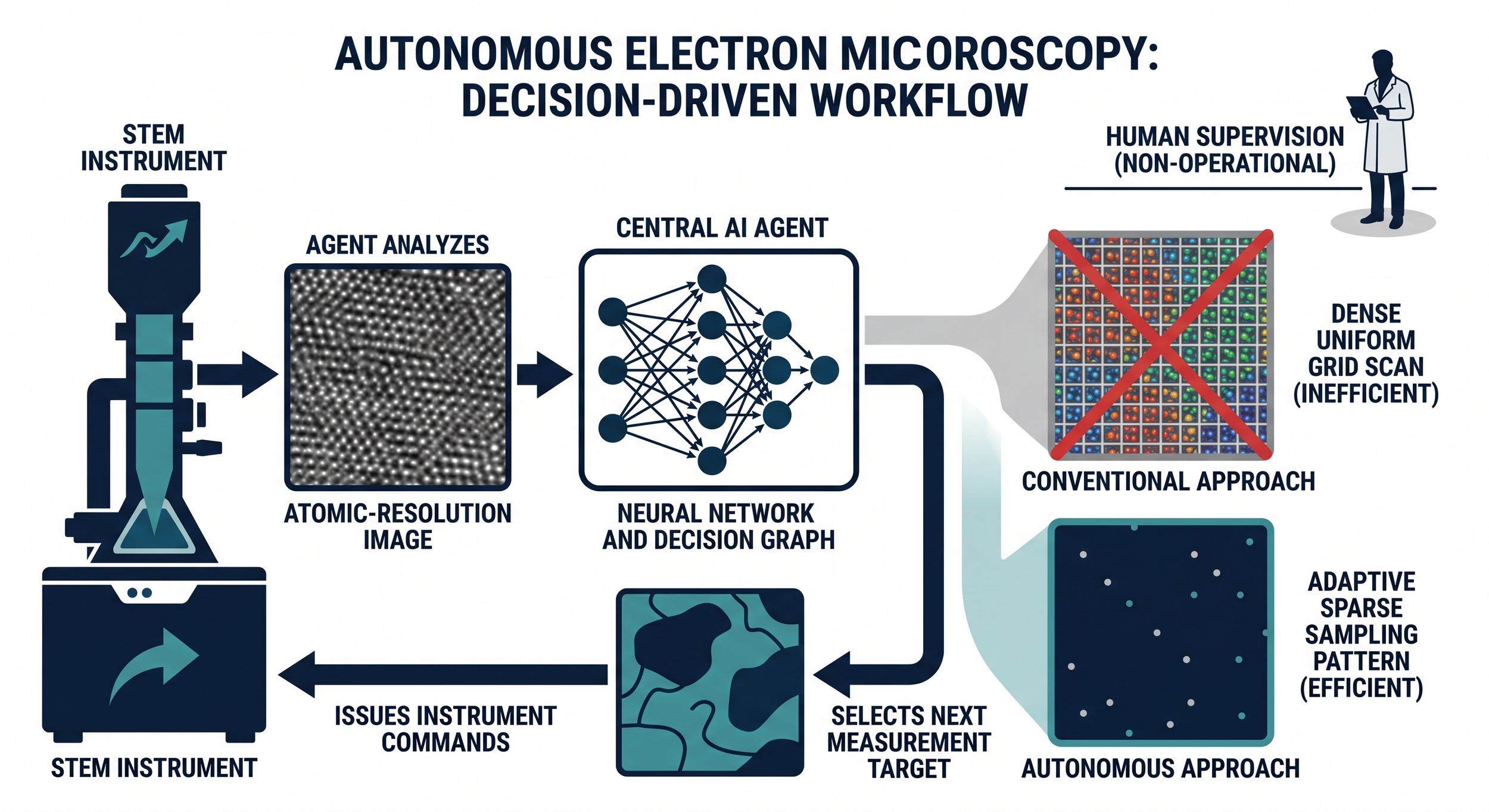
Rethinking big data in microscopy.
Our new perspective in Microscopy Today, led by Sergei Kalinin, challenges a comfortable assumption in the field: that better science follows from more data. Modern instruments already outpace our ability to analyze what they produce, with only ~3% of microscopy data ever reaching publication. The real bottleneck is agency, the capacity to make good experimental decisions at instrument speed rather than human speed.
This framing connects directly to work our group has pursued for years. The Akers et al. npj Computational Materials(2021) few-shot segmentation work and the Olszta et al. automated STEM paper (Microscopy and Microanalysis, 2022) were both built on the premise that sparse, decision-driven measurement outperforms indiscriminate data collection, particularly for beam-sensitive materials where acquisition budget is genuinely limited. Our 2021 Nature Materials perspective made the broader case that the field's bottleneck was shifting from instrumental to analytical and decision-making capability.
The new paper formalizes this with a mathematical framework grounded in reinforcement learning and Bayesian optimization, and makes a strong call for community infrastructure, including vendor-neutral orchestrators, standardized provenance, and validation environments, that remains the field's most significant unmet need. Without shared standards, even excellent autonomous workflows stay bespoke, locked to the lab that built them.