New Publication: Unlocking PEM Electrolysis Degradation with Computer Vision
© 2026 The Authors. Published by American Chemical Society. This publication is licensed under CC-BY-NC-ND 4.0.
Hydrogen shows promise for advanced energy, but realizing its potential requires proton exchange membrane (PEM) electrolyzers that are both efficient and durable at low catalyst loadings. One of the grand challenges in this field is moving beyond simple before and after snapshots to a deep, mechanistic understanding of how catalyst layers degrade under dynamic operating conditions.
In our latest paper published in ACS Applied Energy Materials, titled "Mechanism-Informed Breakdown: Understanding Degradation by Controlling Voltage-Hold Patterns in Proton Exchange Membrane Water Electrolyzers," we tackle this challenge by combining rigorous electrochemical stress testing with advanced, quantitative microscopy.
Led by Ai-Lin Chan and Shaun Alia at NLR, this work investigates the distinct degradation pathways between constant voltage holds and potential cycling. While cycling is known to be detrimental, our multi-modal analysis revealed a fascinating nuance: while cycling leads to disconnected iridium (Ir) agglomerates and ionomer damage, constant voltage holds induce the formation of an interconnected subsurface Ir network. This network maintains electronic connectivity and kinetic performance, even as the catalyst layer thins.
From Qualitative Images to Quantitative Descriptors
As a materials data scientist, my primary interest lies in how we extract statistically meaningful information from electron microscopy data. It is not enough to simply observe that a catalyst layer looks "rougher" or "thinner." To drive materials design, we need robust, quantifiable metrics that correlate directly with electrochemical performance.
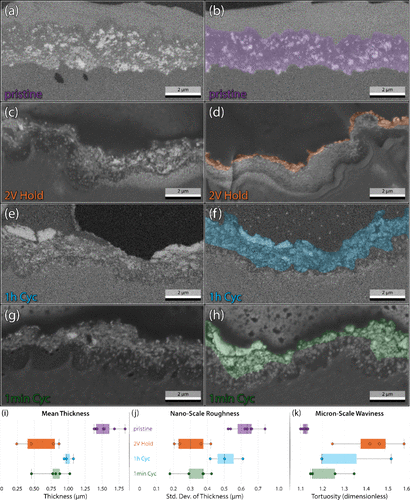
To achieve this, our team developed a custom computer vision pipeline using the OpenCV and Scikit-Image libraries. Rather than relying on manual measurements, this automated routine segments the catalyst layer to extract precise morphological descriptors, including:
Statistical Thickness Profiles: Moving beyond mean thickness to understand local variations.
Interface Roughness: Quantifying the texture of the catalyst-transport layer interface.
Tortuosity & Porosity: Measuring the "waviness" and internal void structure that dictate transport properties.
By applying this pipeline to large-area cryo-SEM cross-sections, we were able to quantitatively link the morphological evolution of the anode catalyst layer—specifically thinning and increased tortuosity—to the kinetic losses observed in electrochemical testing. This approach allows us to bridge the gap between the nano-scale view of the microscope and the macro-scale performance of the device.
Open Source Tools for the Community
We believe that the future of microscopy is open and reproducible. To that end, the image processing pipeline developed for this work, Catalyst-Vision, is publicly available. We encourage the community to use, adapt, and improve upon these tools to accelerate their own degradation studies.
Access the Software: https://github.com/NREL/Catalyst-Vision
This work highlights the power of converging domain expertise in electrochemistry with data-driven characterization. By turning images into data, we are building the ontologies necessary to design the next generation of robust, low-loading electrolyzers.