Preprint: Scandium Diboride as a Lattice and Thermally Matched Substrate for AlGaN
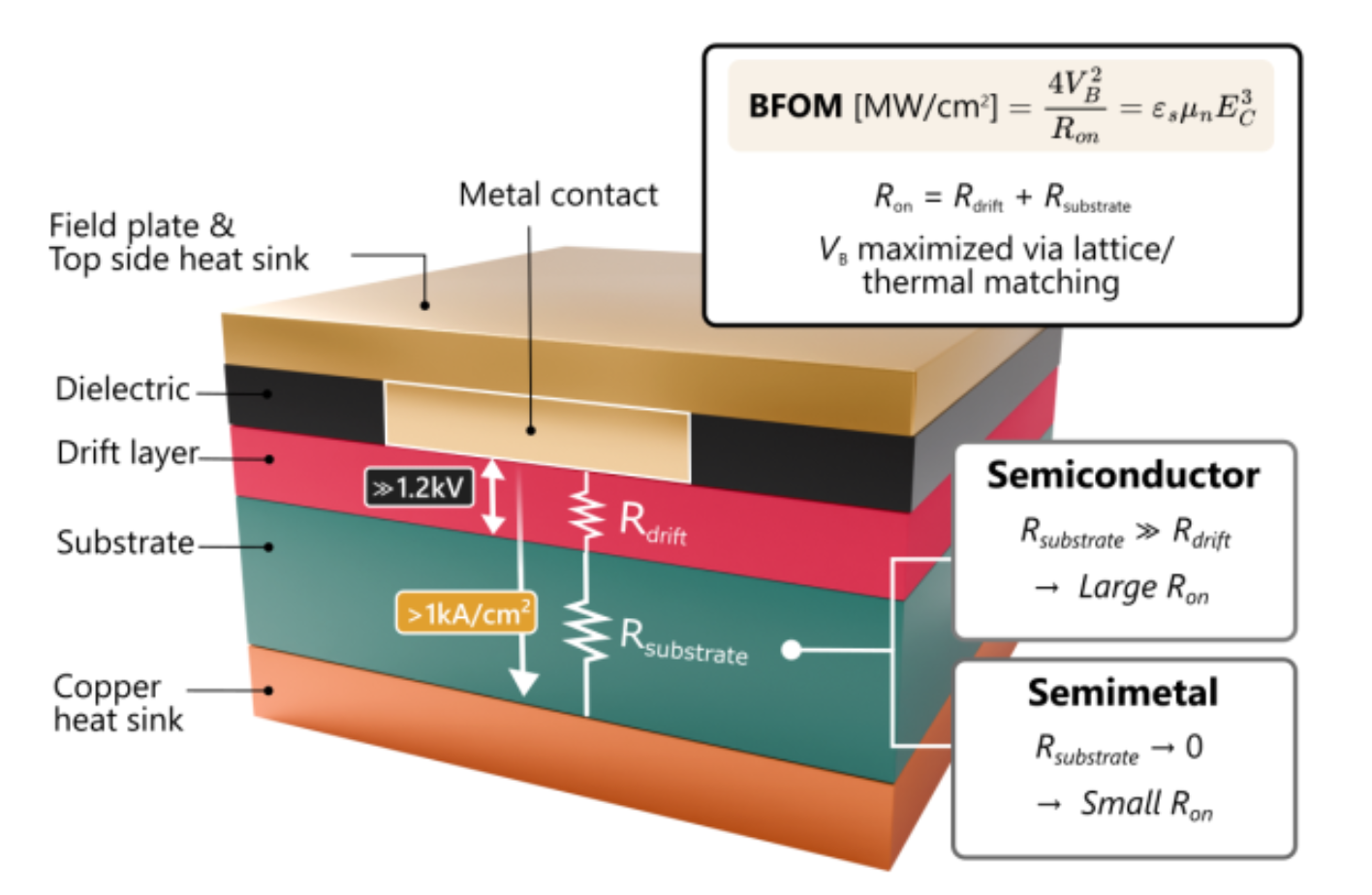
Why the substrate matters in vertical AlGaN power devices.
We recently shared how our APEX team grows ScB₂ crystals at ambient pressure. Today we are sharing the companion study on what those crystals can do, led by MVS Chandrashekhar (Morgan State University) with senior author Satya Kushwaha (Johns Hopkins University and the University of North Texas). The first paper asked whether we could make the crystals. This one asks whether they are the right foundation for high-voltage AlGaN devices. Conventional substrates struggle here because they do not match AlGaN closely enough to grow the thick, low-defect layers that high voltages require, and their own electrical resistance wastes power as heat. ScB₂ is a semimetal whose lattice matches aluminum-rich AlGaN (about 55% Al), with a room-temperature resistivity of roughly 15 μΩ·cm, low enough that the substrate stops being an electrical bottleneck.
The crystals also expand with temperature at a rate similar to AlGaN and conduct heat competitively, with both electrons and phonons contributing. Their vibrational properties, captured by the Debye temperature, are also close to those of AlGaN. That suggests a design criterion that has received little attention: a good substrate should match how the device layer vibrates, not just how its atoms are spaced. Our measurements also suggest that Sc vacancies introduced during boron-rich growth are reducing thermal conductivity below theoretical predictions, which gives us a clear target for improving the growth. This is a continuing story across APEX, and I am grateful to our partners at Johns Hopkins, Morgan State, the University of Maryland, the University of Virginia, Towson University, and NLR.