New Paper on Oxygen Vacancies in PCCP
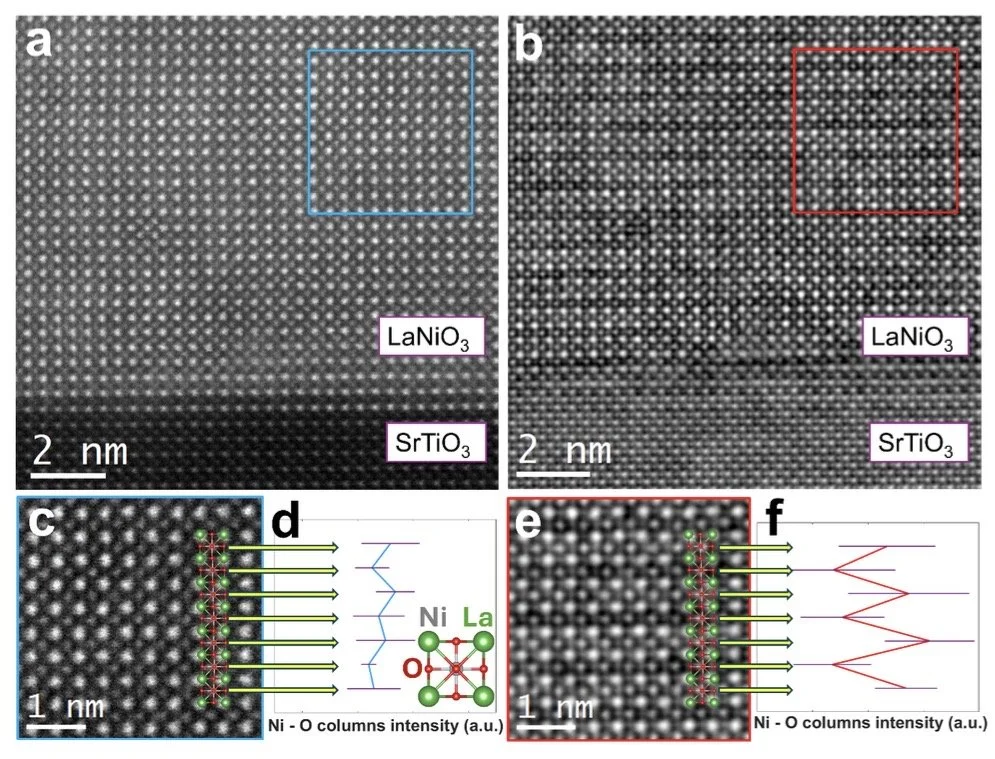
I am pleased to share our latest research, "Strain-Driven Oxygen Vacancy Ordering in LaNiO₃ Thin Films Revealed by Integrated Differential Phase Contrast Imaging in Scanning Transmission Electron Microscopy," recently published in Physical Chemistry Chemical Physics. This work was the result of a strong collaboration, expertly led by Pritam Banerjee of the Technical University of Denmark and Regina Ciancio of the AREA Science Park in Italy.
In this study, we investigated the intricate relationship between lattice strain and the ordering of oxygen vacancies in lanthanum nickelate (LaNiO₃) thin films. These materials are of significant interest for future electronic and energy applications due to their unique properties, which are highly sensitive to atomic-scale defects.
Our team utilized a powerful combination of advanced imaging techniques, including integrated differential phase contrast (iDPC) scanning transmission electron microscopy (STEM), and theoretical modeling. This approach allowed us to directly visualize the arrangement of oxygen atoms with unprecedented clarity. We discovered that compressive strain within the film stabilizes a unique, ordered phase of oxygen vacancies, LaNiO₂.₅, which dramatically influences the material's structure. Furthermore, we found that structural defects known as Ruddlesden-Popper faults can relieve this strain, altering the local arrangement of these vacancies.
This research, which combines experimental work with density functional theory calculations performed by Dr. Peter Sushko at Pacific Northwest National Laboratory, provides crucial insights into how to control material properties through defect engineering. The findings have important implications for the design of next-generation quantum materials and energy conversion technologies.
You can read the full article in Physical Chemistry Chemical Physics here: https://doi.org/10.1039/D5CP02284C