Preprint: Super-Resolution GANs for High-Throughput EBSD of Battery Electrode Materials
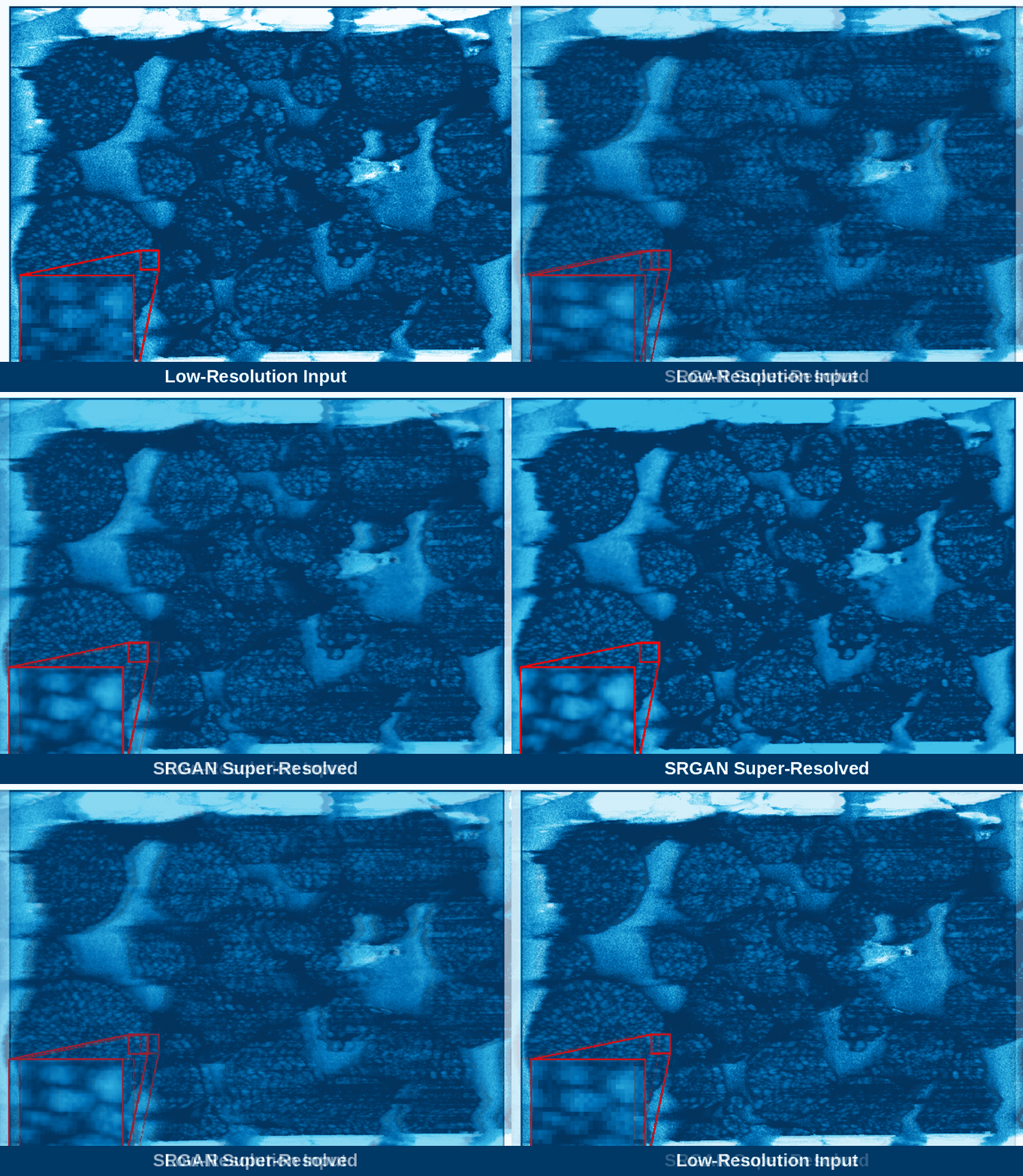
Electron backscatter diffraction (EBSD) stands as one of the most accessible routes to quantitative grain-scale microstructure in Li-ion cathode particles, but its rastering acquisition, one measurement per pixel, imposes a hard throughput ceiling just as the field needs statistically representative datasets across hundreds of particles. In this new preprint, John Mangum, Andrew Glaws, Francois Usseglio-Viretta, Donal Finegan, and I address this gap in software rather than hardware, developing a super-resolution generative adversarial network (SRGAN) trained on EBSD data from LiNiₓMnᵧCoᵤO₂ (NMC) cathode particles and benchmarked against classical interpolation methods across upscaling factors from 2× to 12×.
The SRGAN approach systematically outperforms classical methods in preserving small grains and realistic boundaries. We identify 5× upscaling, corresponding to a 25× effective speed-up in acquisition time or field of view, as a practical operating point, holding relative errors on grain area-equivalent diameter, maximum sphere-inscribed diameter, and boundary length to +5.7%, +8.2%, and −14.6%, respectively. Beyond the accuracy gains, the SRGAN framework produces band contrast and grain boundary reconstructions that remain mutually consistent with one another, a correlation that classical methods fail to preserve. This work moves EBSD toward a genuinely high-throughput characterization tool for both materials research and industrial process development.