Balancing Autonomy and Oversight: Introducing ADAM
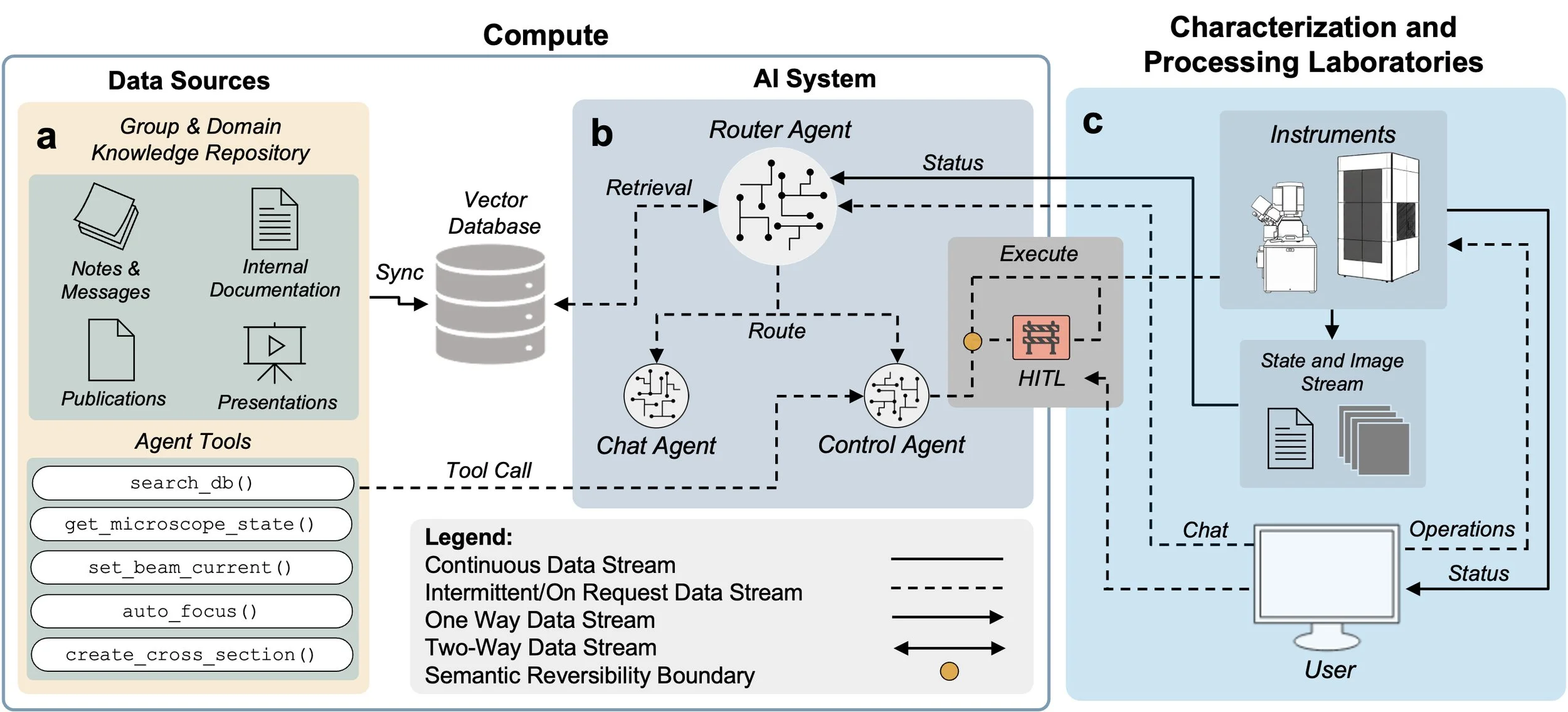
The ADAM architecture harnesses natural language to direct agentic, cross-instrument workflows and domain-grounded reasoning with selective, human-in-the-loop checkpoints inferred at the time of an experiment.
Autonomy in physical science has long been framed as a trade-off: give an AI system enough freedom to be useful, and you risk it taking an action you can't undo; constrain it enough to be safe, and you've built an expensive script that still needs a human at every step. Our group's newest work, "Balancing Autonomy and Oversight in Language-Agent-Guided Physical Experimentation," presents a different answer. We built ADAM, short for Autonomous Decision-making Agent for Materials Experimentation, a multi-agent large language model framework that infers where the line between reversible and irreversible actions sits, moment to moment, directly from the natural language of the experiment itself, rather than hard-coding a fixed set of checkpoints in advance.
What makes ADAM distinct is the breadth of what a single architecture can do. The same reasoning engine carries both general materials science expertise and deep, group-specific knowledge across entirely different instruments, demonstrated on autonomous failure-site identification and ion beam cross-sectioning on a plasma focused ion beam system, and open-ended, hypothesis-driven characterization of an unknown nanoparticle sample on a scanning transmission electron microscope. In both cases, a single natural language prompt is enough for ADAM to plan and execute a full experiment, adapting mid-session and writing new analysis code on request. Most importantly, ADAM doesn't just watch materials, it acts on them, running real ion beam milling and cross-section preparation on live hardware, pausing for human confirmation only at the point where the action becomes irreversible.
This work was led by our exceptional SULI intern Andy Borch, alongside incredible students Emily Avey and Jayden Grunde, with oversight from Renae Gannon and Michelle Smeaton. I'm deeply proud of this team and grateful to lead a group capable of this kind of work. The preprint is available now, and we welcome feedback from the community as autonomous experimentation moves from concept to deployment.