Seeing the Full Picture: Unlocking Material Order with Multi-Modal AI
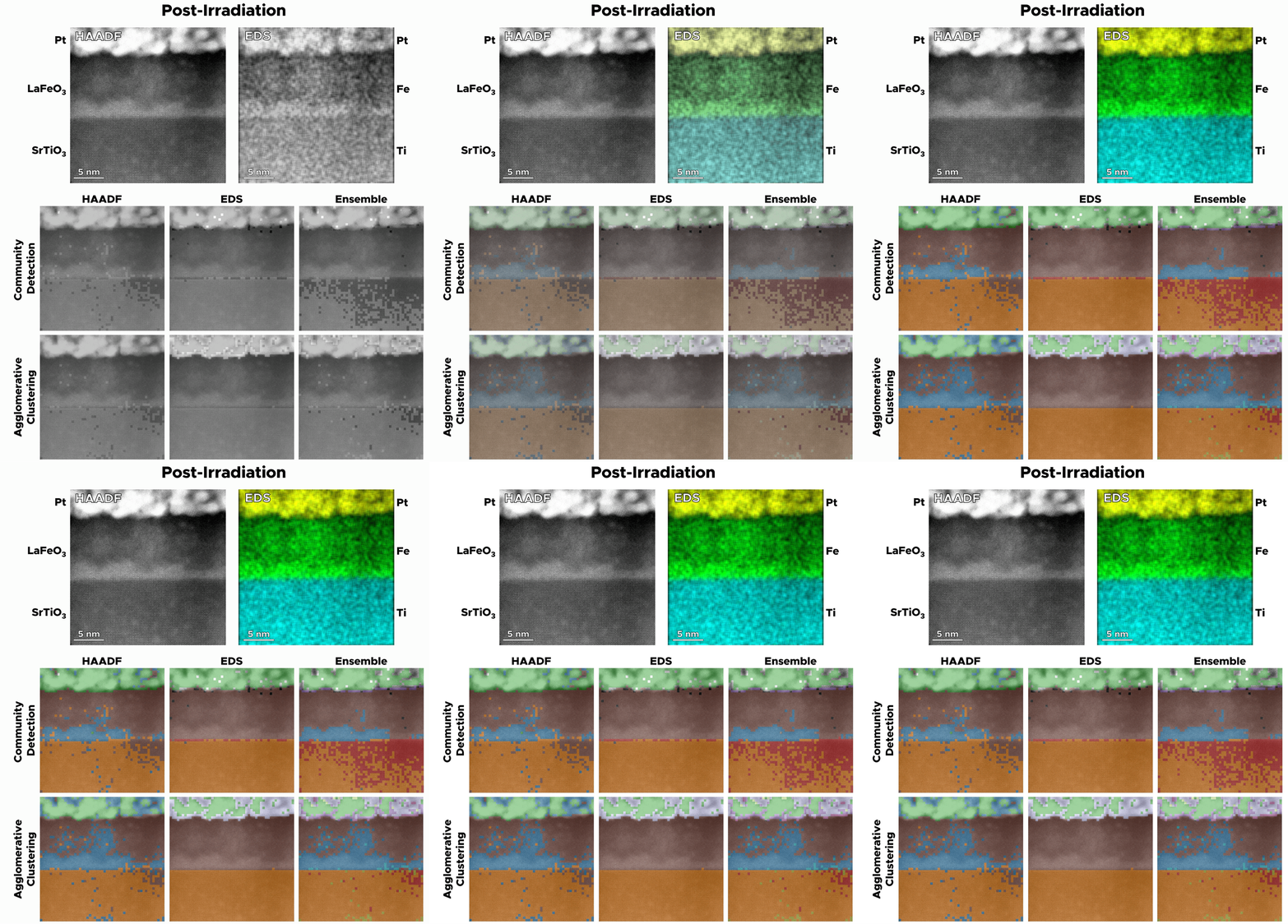
Multi-modal models unique reveal pathways for disorder that affect the properties of functional materials
A fundamental tenet of materials science is that function follows form. To master the performance of devices—whether for quantum computing or extreme environments—we must first master the description of their microstructure. For decades, electron microscopy has been our window into this atomic world. However, we have historically relied on analyzing data streams in isolation: studying an image for structure or a spectrum for chemistry, rarely integrating them statistically at scale.
In our latest work, published in npj Computational Materials, we demonstrate why looking through a single lens is no longer sufficient.
Led by Arman Ter-Petrosyan and a multidisciplinary team at PNNL and NREL, we developed a multi-modal machine learning framework to analyze the complex oxide La1−xSrxFeO3 (LFO). By constructing a pipeline that ensembles fully and semi-supervised classification, we were able to fuse high-angle annular dark field (HAADF) imaging with energy-dispersive X-ray spectroscopy (EDS).
The results revealed what traditional, uni-modal analysis missed. While imaging alone could identify structural boundaries, and spectroscopy alone could identify chemical shifts, only the multi-modal ensemble could accurately describe the subtle evolution of disorder under irradiation. We discovered latent associations—specifically localized oxygen redistribution in disordered regions—that define the material's stability but were previously obscured by the noise of individual data streams.
This work is about more than just better segmentation; it is a step toward true autonomous discovery. By moving beyond laborious, human-in-the-loop analysis, we are creating objective, reproducible descriptors of material order. This capability is critical as we seek to design materials that are resilient in the face of radiation, heat, and pressure.