3D Point Defect Mapping Highlighted in MRS Bulletin
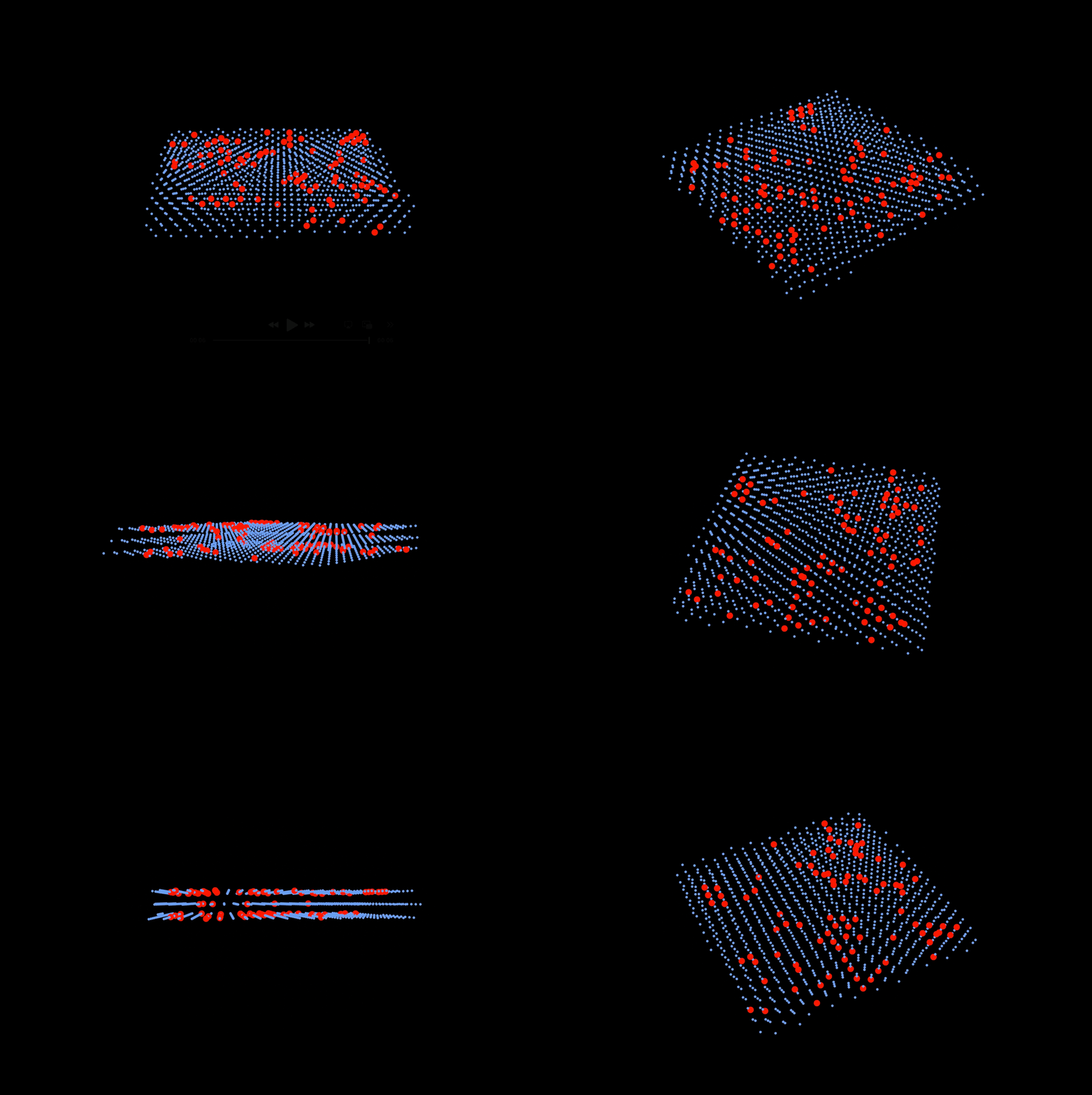
Our former NLR intern Grace Guinan led a study that locates individual point defects in specific atomic planes of Ti₃C₂Tₓ MXene, carried out with Michelle Smeaton, Hilary Egan, and Andrew Glaws at the National Laboratory of the Rockies, Brian Wyatt and Babak Anasori at Purdue University, and Stephen Goldy and Garritt Tucker at Colorado School of Mines. The work was recently featured in a Materials News piece in MRS Bulletin by Ram Munde.
Vacancies left behind by etching largely govern MXene performance, yet scanning transmission electron microscopy collapses depth into a single projected image. We could detect that vacancies were present, but not which layer of a flake they occupied. Grace designed two neural networks built on AtomAI (one for the lattice, one for the vacancies) and a deconvolution strategy that exploits the known hexagonal projection geometry to assign each site to a relative layer. This analysis harnessed exceptional low-dose STEM imaging by Michelle Smeaton. The result is a map of roughly 3000 titanium vacancies across 150,000 lattice sites. Hybrid Monte Carlo and molecular dynamics simulations then probed structural variables that STEM cannot access, indicating that titanium vacancy clustering increases with carbon vacancy concentration and that higher surface termination coverage pushes clusters away from the outermost planes.
We are grateful to Julian Klein (MIT) for his thoughtful comments on the importance of resolving defects along the specimen dimension in very thin materials. The approach stands to be adapted to other layered 2D systems, and we see it as a step toward harnessing AI-guided microscopy to design functional materials with deliberate control over point defects.
Read the MRS Bulletin highlight: https://doi.org/10.1557/s43577-026-01213-9
Read the full paper in Nature Communications: https://doi.org/10.1038/s41467-026-71670-y